
Reflecting on our Week of Multispecies Flourishing

Updated: Jul 24
by Iyan Offor, Alice Di Concetto, Motunrayo Esan, Emily Jones, Isabel Stanley, and Michelle Strauss

The week of multispecies flourishing—a week of events hosted by the Multispecies Collective at the University of Birmingham—saw hundreds of researchers, academics, students, lawyers, policymakers, creatives and more flock to Birmingham to collaborate toward futures of flourishing for animals, nature and society.
As a community, we are left in awe at the creative thinking, effective activism, and wide collaborations on clear display across this movement. We are also left with a deep sense of gratitude for the commitment being made by a broad range of actors to work toward better multispecies futures. From the use of planning law to block factory farming applications to the use of performance and sound to channel the perspective of forests through the vessel of DJ Evergreen, it is clear that there are worlds of ways through which to pursue the futures of flourishing we research and events like these allow our community and network to advance further together than we could alone.
Multispecies Collective PhD Workshop

This year’s edition of the Multispecies Collective PhD workshop was a uniquely interdisciplinary and cross-sector gathering covering animal behaviour, biosciences, composition, educational development, geography, history, legal studies, literary studies, philosophy, political studies, and sustainability. This broad knowledge base facilitated productive conversations about key challenges and opportunities in our work including means of engaging with more-than-human perspectives and lifeworlds and techniques to move between disciplinary traditions in generating knowledge and practice. Our discussions were grounded in multispecies flourishing in various modes, through various lenses, and with regard to various situations. These included soundscape, intersectionality, activism, domestic abuse, insects, victimhood, and assistance dogs. The sheer breadth and depth of expertise and experience in the room made it possible for new ideas and knowledge to be generated by drawing unlikely links, offering new challenges, and exploring new interdisciplinary modes of support and collaboration.
The lively and mutually supportive tone of the day affirmed our instinct that there is a desire for more spaces for deeply interdisciplinary exchanges such as this, and we are so grateful to all of the researchers, discussants and facilitators who enthusiastically applied to join and accepted our invitations. This workshop provided a supportive space for PhD researchers to co-learn with a community of people who not only care about their projects, but who are motivated to ensure their work reaches interested audiences and that they can successfully navigate into careers post-PhD. In this regard, the closing session was a particular highlight where PhD researchers workshopped their ideas with Animal Think Tank and the European Institute for Animal Law & Policy, exploring strategies to measure and enhance the impact of their work. Our design of the workshop was informed by our commitment to linking theory with practice in order to create possibilities for change that would otherwise elude us. We will take these experiences forward and continue crafting spaces for meaningful exchanges like these including in our next PhD workshop in 2027.
UK Animal Law Conference
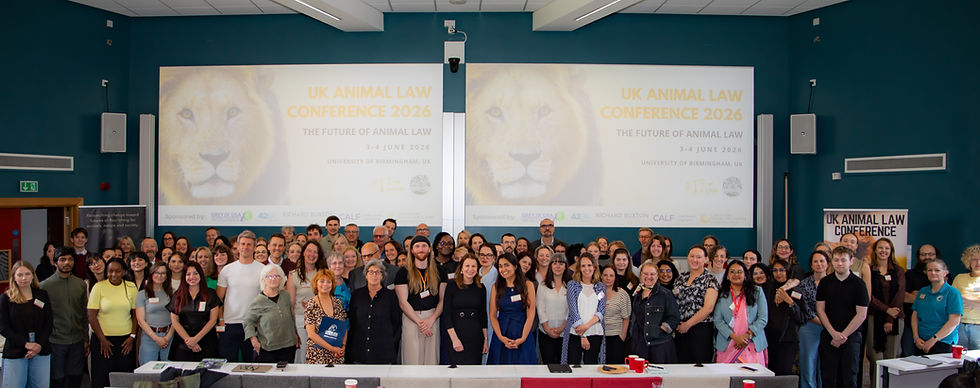
This was our third year co-hosting the UK Animal Law Conference (which has its 10th anniversary in 2027!) and we are delighted to have shaped the unique offerings it makes to the field. The organising team work hard to facilitate a tone of openness, attentiveness, and a welcoming, generous and collaborative environment for collaboration, networking and mutual learning. The authenticity, kindness and diversity of the conversations is something we are incredibly proud of and grateful to our attendees for co-creating with us. It is always encouraging to see the broad spectrum of approaches to animal advocacy and associated values, ideals and theories on display and in fruitful discussion at the conference.
The breadth and depth of scholarship and practice represented at the conference becomes more enhanced each year, fostering genuine moments of deep learning for everyone in attendance. Having presenters and attendees join from across the globe facilitates valuable comparative conversations and the creation of important new collaborations, partnerships and networks which we are always delighted to witness the formation of. The conference feels unique in the depth of its cross-sector approach with lawyers, NGOs, academics, students and more bringing a broad range of experiences into conversation. Some of our most insightful conversations are often about bridging theory, research and academia with policy work, legal practice and other work on the ground. The conference provides important opportunities to reflect on the challenges that exist in this regard, and the opportunities for gap bridging created by forging new connections within our community at the conference.
This year, the conference focused on the future of animal law as its organising theme. Both the fully vegan catering and the immersion in discussion of deeply committed and impactful work across various sectors toward brighter futures for animals in law created an environment that allowed attendees to imagine what such futures might look like. There are many important hurdles to overcome on this journey, not least the continued need to enhance public awareness and understanding of the plight of animals. Yet, the bold and creative initiatives on display at the conference—from a conference sponsor’s work to ban greyhound racing, to a keynote presenter’s new insights on what it means to be alive, to a presenter’s work to stop all new planning permission requests for new factory farms in the UK, and to a special address by Baroness Sue Hayman of Ullock discussing the Animal Welfare Strategy for England—give us hope for the future of animal law in the UK and across the globe.
Aquaculture Law & Policy Symposium

Co-hosting the inaugural Aquaculture Law & Policy Symposium was an eye-opening experience for all in attendance. Intensive aquaculture is an industry of growing concern for animal activists owing to its incredibly detrimental impact on animal wellbeing, environmental and public health. This is compounded by gaps in the available science and the challenge of gaining public sympathy for aquatic animals. This is one of the most pressing welfare issues of the day and we are happy to have provided space for new initiatives to grow in response.
The event’s structure allowed for a very in-depth and productive discussion to be had amongst all attendees. The symposium provided detailed exposition regarding relevant scientific, legal, political and ethical issues through expert presentations followed by ample time for fruitful discussion. The attendance of participants from across the globe allowed for insightful conversation regarding the varying approaches to aquaculture in different jurisdictions, and the way in which solutions can be generated collaboratively that are context specific. The landscape of aquaculture is vastly different in, for example, Australia, India, Nigeria, and the US, which are just some of the contexts we learned about.The symposium ended with an in-depth workshop where participants contributed to the development of an animal protection blueprint for industrial aquaculture. It feels important that a tangible outcome was the result of this gathering tackling an issue of such urgency with such large-scale impacts. We hope this marks the beginning of a surge of activism, law and policy action, and research on intensive aquaculture.
Key Takeaways

One of the central ways we work toward our vision of futures of flourishing for animals, nature and society is to create, host and facilitate events that bring our collective together with our network. This week has been a key moment in this regard and has given us much food for thought. We are very motivated to continue creating collaborative, open, informative spaces such as these to inspire creative thinking, generate productive connections, and discover new opportunities for multispecies flourishing. We hope to welcome you to some of those in the future!


Comments